Designing behavioral change at scale
Turning cultural expectations into observable behaviors and designed a feedback system to help 350+ leaders drive Banco PAN's transformation.
Scope
Behavioral Research · Experience Strategy · Service Design · Gamification · Implementation
My Role
Service Designer
Team

+4
Timeline
2021

Impact Overview
Scale
350–400 leaders throughout Brazil
Organization
around 3,500 employees
Cadence
Quarterly feedback cycles
Context
A bank in the middle of a cultural shift
Banco PAN was moving from a traditional banking culture toward a more digital way of working. The transition was already visible inside the organization, but it was happening unevenly.
Leadership had a central role in making the desired culture tangible. PAN expected its leaders to collaborate, develop their teams, and act as agents of change.
With approximately 350–400 leaders across its São Paulo headquarters and branches throughout Brazil, within an organization of around 3,500 employees, the challenge was systemic.
The People team wanted to rethink its leadership development program as a way to reinforce the desired behaviors across the organization.
Design Challenge
How might we turn organizational expectations into behaviors that leaders could understand, practice, receive feedback on and improve over time?
I led the design work across research, experience strategy, service design and implementation planning.
My contribution included planning and conducting research with leaders and employees, synthesizing behavioral profiles, facilitating workshops with HR Business Partners, translating behavioral insights into the service experience, designing the gamification strategy, defining the program's communication framework, modeling its reward system, and preparing the rollout and operational handoff.
I worked alongside an HR consultant, who was responsible for defining the leadership guidelines and the measurement criteria and metrics. Banco PAN's People team contributed organizational knowledge and would ultimately operate the program after our consultancy engagement ended.
Research
Understanding the system
Leadership behavior affects more than leaders
We could not design a leadership development system by talking only to the people being evaluated. Leadership existed within a broader organizational system involving four groups:
Leaders would receive feedback and act on their development.
Employees experienced leadership behaviors every day and would participate in their evaluation.
HR Business Partners would support the process across different areas and provide operational data.
People Development needed to connect the program to PAN's broader culture and leadership strategy, then sustain it after the consultancy left.
Each group had a different relationship with the program. A useful experience for leaders could still fail if employees did not trust it, if Business Partners could not operate it, or if People Development could not sustain it.
Researching both sides of leadership
We conducted in-depth interviews with 10 PAN leaders to understand how they perceived leadership, feedback, recognition, professional development and the cultural transformation happening around them.
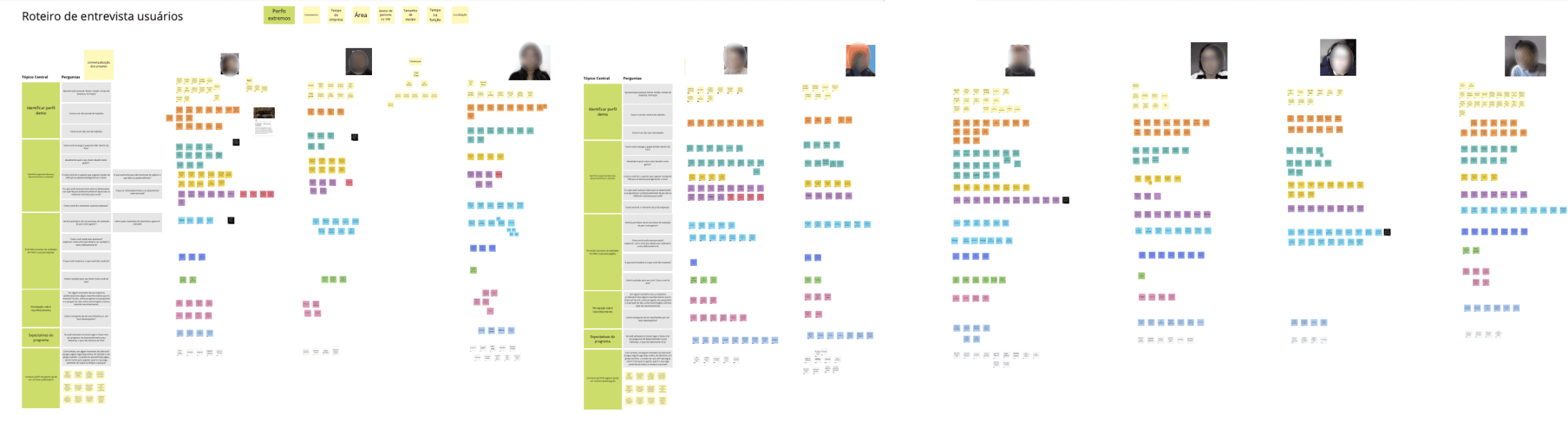
We also surveyed employees to understand their perspective about leadership. It was essential because leadership expectations are relational: how a leader understands their own behavior is not necessarily how their team experiences it.
Employees helped us identify which behaviors mattered in daily work, what they expected to change and what would make an evaluation process credible.
This gave us two complementary perspectives:
How leaders perceived their own development
How employees experienced leadership in practice
Could the organization actually operate it?
A behavioral strategy would not matter if PAN could not sustain it. We facilitated workshops with HR Business Partners to understand how the evaluation could work across different areas of the bank.

Together, we explored responsibilities, operational constraints, the feasibility of different evaluation cadences, how metrics would be collected and the support BPs would need to provide to leaders.
The research therefore examined desirability and operability at the same time: the program had to make sense to leaders and employees while remaining realistic for HR to run across the organization.
Synthesis
What we learned
Culture needed to become something people could see
PAN already had expectations about what good leadership should look like. The company wanted to encourage behaviors such as:
working collaboratively;
taking ownership;
developing and guiding teams;
connecting decisions to company strategy;
acting as an agent of change;
moving with speed;
delivering business results.
It also wanted to discourage favoritism, micromanagement, lack of transparency, weak performance management and the transfer of leadership responsibilities to HR.
Instead of leaving concepts such as autonomy, collaboration and people development as abstract values, we connected them to situations employees could recognize.
Autonomy could be observed in whether leaders gave teams room to make decisions.
Collaboration could be observed in whether different perspectives were invited and discussed constructively.
People development could be observed through feedback, development opportunities and career support.
This translation made culture actionable: employees could observe it, leaders could receive feedback on it, and HR could support its development over time.
Evidence → behavioral expectation → observable action → feedback → development
The transformation was happening at different speeds
Leaders had very different relationships with that transformation. Some worked close to innovation and actively questioned existing processes. Others experienced change mainly through operational issues and spent much of their time resolving them. More experienced leaders could feel further removed from the transformation happening elsewhere in the organization.
We mapped these differences across time at PAN and response to change, which led to four recurring behavioral profiles.

These were not demographic personas. They represented different relationships with change and different sources of motivation within the same leadership population.
That distinction created an important design tension: a single motivational device could engage one profile while alienating another. The program would need to balance progress, recognition, autonomy, social connection and visible impact.
Solution
Designing the behavioral change system
Two complementary views of leadership
The program combined two perspectives that answered different questions.
Líder +
Captured how leadership was experienced by employees.
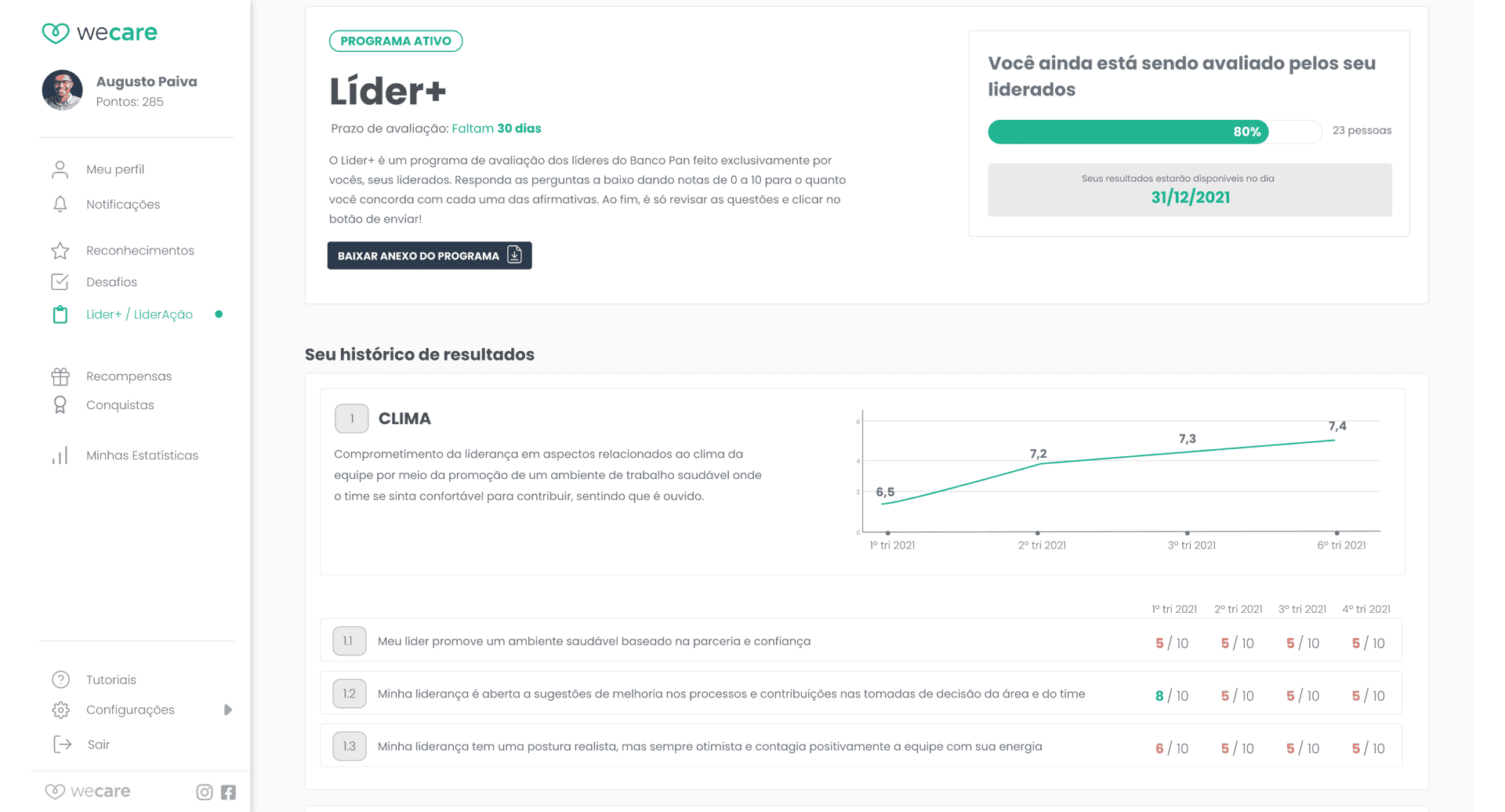
Employees evaluated observable behaviors across areas such as climate, purpose, recognition, people development and culture.
LíderAção
Brought in measurable leadership actions, using HR data in areas such as feedback, training, diversity and inclusion, and quality of life.
HR Business Partners were responsible for providing these metrics during each evaluation cycle.
Together, they gave leaders a more complete signal: What their teams experienced + what their actions showed
This helped position the program as a development system rather than a one-dimensional performance score.
From periodic evaluation to continuous development
The evaluation was only one moment in the experience. We designed recurring quarterly cycles so leaders could receive feedback, interpret it, act on it and observe change in the following evaluation.
The behavioral loop was:
Set expectations → Observe → Evaluate → Understand → Develop → Reinforce → Repeat
Evaluation
At the beginning of each cycle, leaders and employees needed to understand what was being evaluated and why. Employees evaluated the behaviors they experienced through Líder+, while Business Partners provided LíderAção metrics.

Feedback
Leaders then received preliminary results in a personal dashboard, reviewed the evidence, and discussed development opportunities with HR. After the review period, final results became the baseline for the next development cycle. Over time, leaders could see whether behaviors were being sustained, improved, or changed.
Designing trust into the process
Behavioral evaluation is sensitive. A feedback only works when people trust how it was produced. If leaders did not trust the process, it would be difficult for them to use the results as a basis for development.
We therefore included a contestation period between preliminary and final results:
Leaders could review their evaluation and question results they believed were incorrect. HR Business Partners would assess those cases before the final results were published.
Clear criteria, visible rules and the possibility of review were part of the experience and necessary conditions for engagement.
Service journey Blueprint
The annual service journey blueprint connected these moments across leaders, employees, Business Partners, People Development, and the team operating the platform.

Gamification as reinforcement: Supporting motivation without reducing development to a game
After defining the core behavioral system, we explored how to sustain engagement across repeated cycles.

Using the behavioral profiles and the Octalysis framework, we mapped different motivational drivers and assessed which mechanics could reinforce the desired behaviors.


The research pointed to recurring needs around progress, recognition, achievement, social interaction and visible impact.
This informed a balanced set of mechanics:
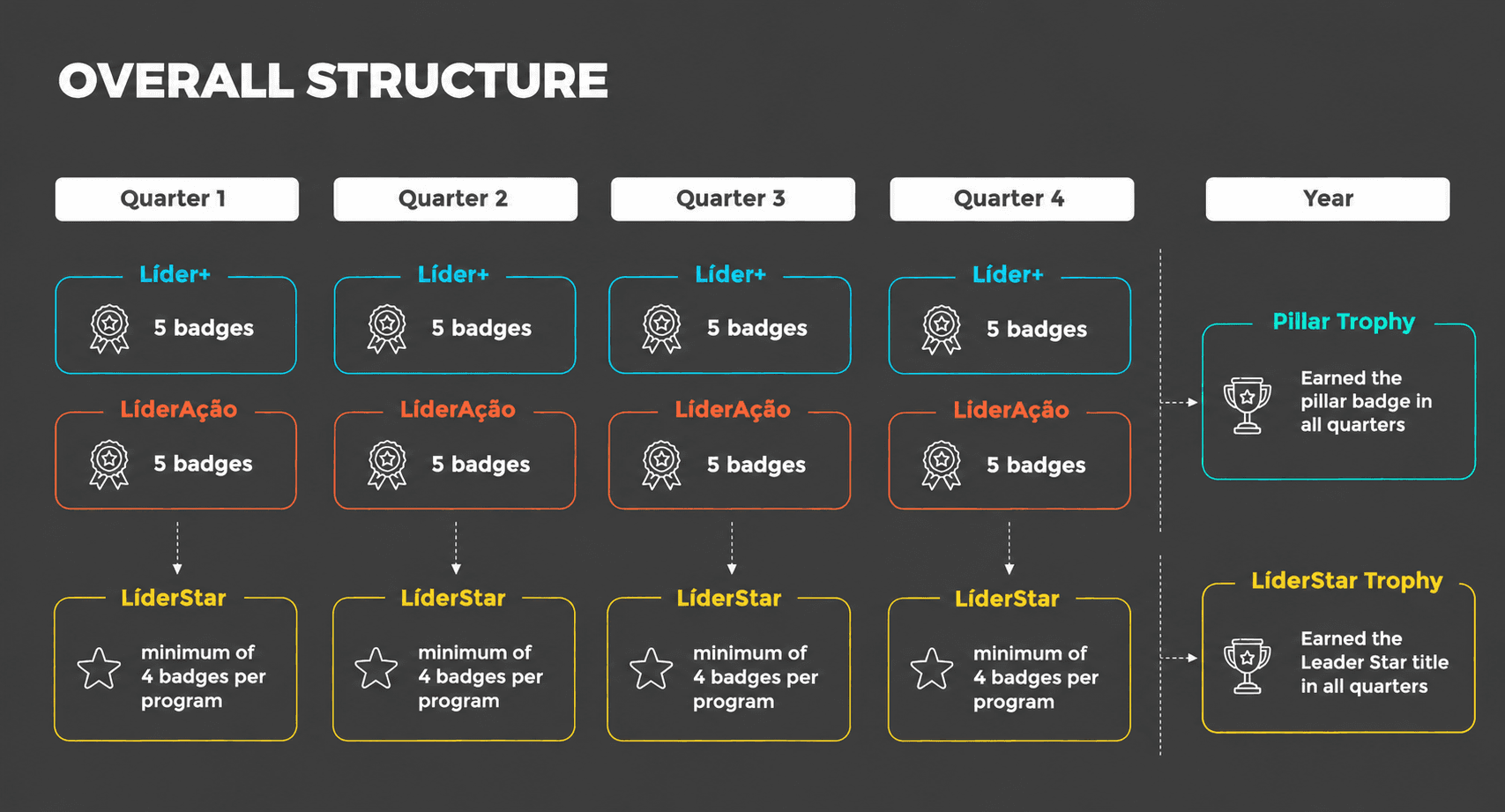
Badges made accomplishments and behavioral strengths visible.
Progress history showed how results evolved across cycles.
Recognition reinforced consistent performance without making competition the only motivator.
Collective achievements connected individual development to PAN's wider cultural transformation.
Rewards provided a tangible incentive for participation and continuity.
Making individual and collective progress visible
The system needed to avoid framing cultural change as an isolated competition between leaders.
At the individual level, each leader could follow their badges, results and development history across quarters. This shifted attention from a static score toward an ongoing question: How am I developing?

At the collective level, aggregated progress could show how leadership behaviors were evolving across the organization. This linked personal action to a transformation larger than any single participant.

Individual and collective views served different motivational needs while reinforcing the same cultural direction.
BitPAN: adapting a platform capability into an incentive strategy
BitPAN did not exist as a previous PAN reward currency that we merely integrated. The selected implementation platform already offered a points or currency capability, and we chose to explore that functionality as part of the program's gamification strategy.
Leaders could convert achievements represented by badges into BitPAN, which could later be exchanged for items or benefits in the platform's own marketplace.
I modeled the value and conversion logic of the badges by considering:
the available reward budget;
the estimated number of participating leaders;
the frequency of evaluation and recognition;
the number of cycles in the program;
the expected distribution of achievements;
and the need to keep the system financially sustainable over time.
This turned a generic platform capability into a reward mechanism connected to PAN's behavioral and operational context.
Designing the communication journey
A recurring program depends on more than the evaluation interface. People need to know what is happening, why it matters and what they should do next.
I planned a communication framework aligned with the service journey. It defined the moments that required communication, the behavioral purpose of each touchpoint and the most appropriate channels and formats.
The framework covered triggers such as:
program launch and expectation-setting;
opening and closing of evaluation windows;
reminders for employees and HR Business Partners;
preliminary results becoming available;
the contestation period;
publication of final results;
recognition and reward moments;
development follow-ups;
and preparation for the next cycle.
For each trigger, we considered audience, message intent, timing, channel and format—from platform notifications and email to manager or HR conversations.
My scope was the communication strategy and cadence, not the final visual production of every asset.
Designing for the organization that would inherit the system
The consultancy would not operate the program indefinitely. PAN needed to understand, launch and sustain it after our engagement ended.
We translated the concept into an implementation plan covering the activities, dependencies and responsibilities required to move from design to operation. The rollout considered:
platform configuration and ownership;
preparation of Líder+ and LíderAção inputs;
roles for People Development and HR Business Partners;
participant onboarding and communication;
cycle calendars and operational checkpoints;
rules for preliminary results and contestation;
reward-budget governance and BitPAN parameters;
validation and adjustment before broader rollout;
and documentation for ongoing operation.
The handoff was therefore not a final presentation. It was the transfer of a service model: logic, journeys, rules, responsibilities, communication triggers and decision points that PAN's team could operate and evolve.
Outcome
A foundation for continuous leadership development
The project delivered a validated concept and implementation foundation for a recurring leadership development system connecting:
Organizational expectations → employee feedback → measurable actions → recognition → individual development → cultural change
The work gave PAN:
platform configuration and ownership;
preparation of Líder+ and LíderAção inputs;
roles for People Development and HR Business Partners;
participant onboarding and communication;
cycle calendars and operational checkpoints;
rules for preliminary results and contestation;
reward-budget governance and BitPAN parameters;
validation and adjustment before broader rollout;
and documentation for ongoing operation.
The behavioral profiles also became a reusable lens for understanding different relationships with change and motivation beyond the immediate program.
This case does not claim post-launch quantitative impact that was not available to the project team. The evidence we did obtain came from validation: participants regarded the model as clear, feasible, fair and potentially capable of influencing leadership behavior.
What I learned
A foundation for continuous leadership development
Behavioral change depends on the system around the interface
The most important lesson was that organizational behavior cannot be changed through mechanics alone. Points, badges and rewards can reinforce action, but they cannot replace clear expectations, credible evidence, psychological safety, development support and an operation that people trust.
Research also showed that leaders who look similar in an org chart can respond very differently to change. Designing for those differences led us away from a one-size-fits-all incentive model and toward an experience balancing recognition, progress, autonomy and collective purpose.
Finally, the project reinforced that organizational context is part of the user experience. The effectiveness of the program depended on PAN's culture, HR processes, leadership expectations, communication, platform constraints and operational ownership—not only on the screens participants would see.
Designing the experience meant designing across all of those layers.
Credits and responsibilities
my contribution
Research planning and execution · Leader and employee interviews · Behavioral synthesis and profiles · HR Business Partner workshops · Experience strategy · Service journey · Gamification strategy · BitPAN reward modeling · Communication framework · Rollout planning · Operational handoff
HR consultant
Leadership guidelines · Measurement criteria and metrics
Banco PAN People team and HR Business Partners
Organizational context · Operational input · HR data · Program ownership and continuity
